The old capital - Ayutthaya
Day 7 Friday, April 6, 2018 Travel to Ayutthaya
 Janet is enjoying Sticky Rice, which we learned about during a roadside stop on today's drive to Ayutthaya, the Siamese capital for 400 years.
 Before we departed the Midi Resort, I went down by the river to get one more look at the Kwai River at low flow, with the sand bars and tall mountains off to the west. We departed after breakfast, heading south a bit before turning east. Ayutthaya is located directly north of Bangkok, in fact on the same river.
 Along the way, we pulled over to this roadside market to sample their Sticky Rice. Nu explained that it was a favorite treat in the part of the country. He described exactly how they make it - soaking the rice over night, adding coconut cream and sugar, cooking that up, then stuffing a portion into a bamboo stick, and roasting that over a charcoal fire for 3.5 hours. During our stop, we could witness this entire process at its various stages.
 Here are the bamboo sticks with the rice mixture, ready to be cooked.
 There they are being roasted over the charcoal grill.
 And there they are ready for sale behind the counter. They put a colored paper cap on each one to indicate which additional flavors had been added to the mix, such as pumpkin. All our group bought one, and Janet and I bought three - one to eat later.
 Once you purchase one, the lady hands it to this guy who hacks the bamboo with a big knife so that you can pull apart the stick to get to the Sticky Rice. They had spoons there, but I found it easier just to pick it up by hand since it was a thick semi-solid consistency. Yes, they tasted pretty darned good.
 As we continued east, we passed by rows and rows of their national tree, with these bright yellow flowers. Nu said its name is Golden Showers, and the whole bus cracked up along with Nu. One thing we liked about Nu was that he always would laugh at his own jokes, which made him even funnier. Because "golden showers" has a nasty meaning, Nu said he would call it "Yellow Rain." He started laughing again, and we actually weren't sure which name was actually correct. Turns out, the true name in English is Golden Showers.
 After a while we stopped at a gas station/7-11 store for a potty and snack break. I wandered off a bit to look around and thought this tree with those huge fruits was interesting. Janet and I weren't hungry enough to purchase any snacks at the 7-11, so I was surprised to see how much food everyone else was buying. It hadn't been too long since we had our all-you-can-eat breakfast, and then the Sticky Rice.
 We continued on, and before too long, the bus pulled over to the side of the road so that Nu could show us and explain about growing rice. I'm forgetting the details...Maybe Janet will remember and can edit this later. Nu told a "legend" about why Thais eat white rice instead of brown: One of the kings was given brown rice and remarked that he "must be poor and a prisoner" to be given such dirty-looking rice. The next day, they milled it until it was white, the king was happy, and his subjects followed suit.
 As we got closer to Ayutthaya, we drove off onto a small country road and stopped at a "resort" for lunch. It didn't really look like a resort when we stopped, although the dwellings in the background of this picture look pretty fancy. The buffet meal was one of Janet's favorites of the trip, especially the coconut cream soup. When I took this photo, it was just going to be the two of us at the table. But then Glorietta, the Spanish teacher from Seattle, called out to see if we would join her and her husband. Oh, that meant listening to Juan Antonio talk non-stop, even though we could rarely understand him. Oh well, it was a nice Thai-food lunch.
 Nu told us about these "cannon ball" fruits near where we were eating, so I took the picture.
 Yet one more spirit house, this one where we had our lunch.
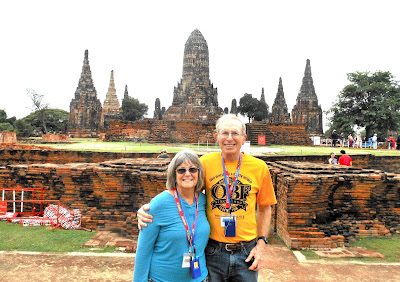
 Once we departed the lunch, we drove only a short distance to this old temple (1357) in Ayutthaya, called Wat Yai Chai Mongkhon. From a distance, the tall tower was leaning to one side, and Nu called it the "Leaning Tower of Ayutthaya."
Most of the entire town is a UNESCO World Heritage site, due to the remaining ruins from the dynasty when this was the spectacular capital of Siam - from 1350 to 1767, when the Burmese conquered the city and looted all the riches.
European visitors to Ayutthaya during its heyday reported back to the world that it was the most spectacular city in the entire world. Gold everywhere. But then after 1767 it fell into ruin.
 A small temple within the temple.
 This temple also had a reclining Buddha, this one with a new yellow covering. It was REALLY hot and humid that day. We actually were supposed to visit another temple after this one, but Nu decided that we would see the other one the next morning and get us to the hotel. It was an excellent decision!
 This was inside their temple. Notice the monk statue in the case on the right. We hadn't seen this before at the temples we'd visited.
 And this was the Buddha just outside the doors to the temple. The bright gold color reminds me of a story Nu told about when the Burmese looted the town: One of the Buddhas at that time had 550 lbs of gold (!!) coating it, and it was all melted down and taken back to Burma.
But it was the opposite for another situation: The town had a solid gold Buddha that weighed 5.5 tons! Thai locals covered it with a layer of stucco and colored glass to conceal its true value. It worked! The Burmese invaders missed it, but it also was "lost" to the Thais for almost 200 years, ending up at what was then a pagoda of minor significance. During relocation of the statue in 1955, the plaster was chipped off and the gold revealed. It was then moved to a temple in Bangkok, where it remains today. At the current price of gold, it's worth over $250 million!
 This temple had these smaller Buddha statues completely surrounding it. They are newer, but you can see the ruins of other parts of the temple in the foreground and background.
 These are the same statues on another side, and they had received their yellow cloth coverings from a group adding them that afternoon.
 Here were the workers adding the cloth to the huge Buddha to the side of the temple.
Most of us, including Janet and me, walked up the steep long steps into the top of the pagoda, thinking it would contain interesting stuff, but it did not. It just got us hotter and sweatier, so we were relived to finally get back on our A/C bus and drive to our hotel in the downtown.
 Our hotel was an older one (I guessed 1962), but still elegant. Here's the view out our room window. That river was commercial, with large barges going by frequently. The land to the left is the old main city, completely surrounded by the water of three rivers. This is why it was chosen in the 14th century to be the capital - it had a natural moat. In the lower foreground you can see a temple, which a bit later Janet and I visited on our walk.
 And here we are about to enter that temple on our late-afternoon walk (despite the heat). Between our hotel and this temple, we walked past five-in-a-row massage parlors of questionable repute. Some of the ladies in the windows called out to us to visit them. As along virtually all the city streets we'd seen on our trip, the sidewalks were solid with vendors selling mostly food, their woks hot and ready.
 Scenes from inside the temple. We weren't sure that we were supposed to wandering around in there, but we just kept walking and no one ever told us to leave.
 Lots to see in there.
 So much elaborate glory in these temples. It also had a river dock, presumably for worshipers to arrive by boat.
 We are leaving, and we decided to continue down the street to see what else we might see.
 We came across Susie from our group, who said she was just so tired that she didn't even want to walk the 200 yards back to the hotel. She'd rather rent a motorcycle taxi for 50 Bhat ($1.60), and so she did! That's the train station in the background, which is why this area was so crowded and full of taxis and vendors of all sorts.
 After wandering around for another 20 minutes or so, we walked on back. We thought this sight was interesting, on a feeder river into the main river. Shacks and poverty, right next to the elaborate temple (you can see its roof on the upper left).
 We were stunned to see all this trash and garbage just tossed down between the bridge we were on, and the temple building on the right. We wondered why the city would not clean this up, and why people toss their trash like that in the first place?
No more photos for the day. We had a wonderful family-style dinner in the hotel, covered by the tour. We had an interesting conversation with the Latinas from Queens, who seemed to travel a lot for working for a non-profit. Back in the room, our remaining beers had cooled off in the fridge, so we enjoyed those as we relaxed a bit before going to bed.


Most of the entire town is a UNESCO World Heritage site, due to the remaining ruins from the dynasty when this was the spectacular capital of Siam - from 1350 to 1767, when the Burmese conquered the city and looted all the riches.
European visitors to Ayutthaya during its heyday reported back to the world that it was the most spectacular city in the entire world. Gold everywhere. But then after 1767 it fell into ruin.


But it was the opposite for another situation: The town had a solid gold Buddha that weighed 5.5 tons! Thai locals covered it with a layer of stucco and colored glass to conceal its true value. It worked! The Burmese invaders missed it, but it also was "lost" to the Thais for almost 200 years, ending up at what was then a pagoda of minor significance. During relocation of the statue in 1955, the plaster was chipped off and the gold revealed. It was then moved to a temple in Bangkok, where it remains today. At the current price of gold, it's worth over $250 million!


Most of us, including Janet and me, walked up the steep long steps into the top of the pagoda, thinking it would contain interesting stuff, but it did not. It just got us hotter and sweatier, so we were relived to finally get back on our A/C bus and drive to our hotel in the downtown.


No more photos for the day. We had a wonderful family-style dinner in the hotel, covered by the tour. We had an interesting conversation with the Latinas from Queens, who seemed to travel a lot for working for a non-profit. Back in the room, our remaining beers had cooled off in the fridge, so we enjoyed those as we relaxed a bit before going to bed.

Comments
Post a Comment